Friday, 1 January 2010

Travels In Ghana

Over this last week, we have been travelling around and learning more about the history and culture of Ghana.


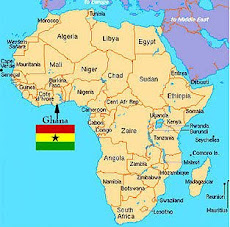
Ancient Ghana was originally situated near the current border between Mali and Mauritania, and it reached the height of its powers in the 9th and 10th centuries. When the Gold Coast gained its independence from Britain, Nkrumah chose the name Ghana for the country, in recognition of this ancient kingdom.

There is evidence of human habitation in Ghana, dating back 300,000 years. However Ghana, as a nation, was only created in the last century, during the European "scramble for Africa". There was little regard for the indigenous people and languages within its borders. Hence, around fifty distinct groups are to be found in modern Ghana, each with its own dialect, culture, history and traditions. This trip is certainly enabling us to gain a bit more of an understanding of the complexities of the country.

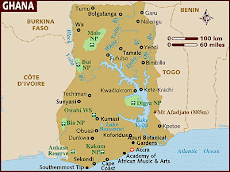
Some of the highlights of this week’s travels are outlined below.

Shai Hills Reserve

This reserve is close to Accra and is the homeland of the Shai people, who say that they originally came from Israel. They inhabited this area until 1892, when they were ejected by the British. There were 4 tribes who used the caves as palaces for the chiefs. We climbed to one of the caves, where we saw the chief’s stool (throne) carved into the rocks. Shai people now live in surrounding villages and all the employees of the reserve belong to the Shai community. Once a year, members of the community return to the caves to carry out various rituals, related to their traditional beliefs. The reserve supports a range of wildlife, including herds of Kop antelopes, numerous snakes, and 19 troops of baboons.


Torgome Village

This large fishing village of 8,000 people is situated on the eastern side of the Volta River, just south of Akosombo. Given its location, we were surprised to find just how much the village is cut off from most aspects of modern Ghanaian life. We were invited by the Paramount Chief, the elders and the villagers to take part in a traditional naming ceremony and we were both given African names. Linda, as a Monday born female, is called Adzowa, and was given the additional name of Xorla, i.e “redeemer”! Haydn, born on a Tuesday, is called Kwabla, and was also named Nunya, meaning wisdom.

The ceremony consisted of a Christian prayer, followed by a traditional prayer. This was to ensure that the Christian God, as well as the lesser gods and spirits of the ancestors would all be present for the ceremony. There was then a libation (ritual pouring of a drink onto the ground for the gods and ancestors). This was followed by a wonderful display of singing, dancing and drumming. Then there were speeches, including on-the-spot speeches from each of us, as this was clearly expected. We were presented with traditional bracelets and 2 clay pots made in the village – and were then made to dance with the villagers. (This naming ceremony is usually carried out when a child is 8 days old. If a child dies before this, then the child is not mourned, as s/he did not have a name and therefore did not exist.)

We were invited to look around the health and educational facilities of the village, meeting a wonderful nurse who has been working at the village’s clinic for 13 years. Apparently, malaria is still the biggest health issue, even though this is largely preventable. Unlike a number of the northern villages, Torgome has electricity and a water supply, although the health and educational facilities are absolutely basic. Some images of the naming ceremony are shown below.


Akosombo Dam and Lake Volta


The earth dam at Akosombo was built in the 1960’s and has created the world’s largest artificial lake. The hydro-electric power station provides the major part of Ghana’s electricity. Once Nkrumah realised the Americans were keen on the project, so that they could extract and profit from the bauxite (aluminium ore) in the excavations, he tried to take more control of the project for Ghana. According to local historians, the CIA then backed the coup d’etat that removed Nkrumah from power in 1966. Things don’t change, do they!


Wli waterfalls


Whilst in the Volta region, we went up country to the border with Togo. This area of the country was part of German Togoland until 1919. Whilst there, we visited Wli Falls, the highest waterfall in West Africa - and the water was flowing!


Tafi Atome Monkey reserve

We paid a delightful visit to the village of Tafi Atome, where the sacred monkeys have a sanctuary in the local forest. Our guide, John, took some bananas and, as we approached a particular area, he started to call the monkeys... and lo and behold they appeared.

He introduced us to the King of the Mona monkey troop and then we used the bananas to get them feeding from our hands. He explained the tradition surrounding the monkeys. The people of the area originally came from the West of Ghana. As they travelled they prayed to their gods, and the monkeys escorted them all the way to Tafi Atome. This led the people to believe that the monkeys were the messengers of the gods, protecting them. There are currently shrines to the gods in the forest, and rituals are still carried out by the traditional believers. However, most people in the area have become Christians, and they started to destroy the forest and kill the monkeys during the 1980s. The reserve was set up in 1996 to protect the forest and monkeys, and to ensure that all income from the reserve goes to the local community and is also used to maintain the reserve.


The Du Bois Memorial

From the Volta Region, we travelled south again. In Accra we visited the W.E.B. du Bois Memorial Centre and Mausoleum. This guy was a key founder of Pan Africanism, being the first black person to gain a PhD from Harvard University. In the 1940s, he brought Nkrumah, Kenyatta and others together, in order to plan for the independence of all African countries. Du Bois was brought to live in Ghana in his 90’s, after independence, and was eventually buried in Accra. He clearly had a huge influence on Nkrumah and, like a number of leaders in the 40s – 60s, he was deemed to be a dangerous communist by the CIA.


Kakum National Park

This is a magnificent piece of tropical rain forest, with a spectacular canopy walk that Haydn relished. These amazing wood and rope bridges enable people to walk amongst the tree tops, at 30 – 40 metres above the ground. For those who know Linda’s fear of heights, it will not surprise you to know that she settled for the nature walk.


Slave Castles

We have spent some time exploring the slave castles of Cape Coast and Elmina. Obviously we have learned much about the slave trade over the years. We have seen exhibitions, memorials and remnants of the slave trade in Liverpool/Bristol and in Jamaica/USA. Now, to complete the "triangle" on the West African coast is a great privilege. However, it isn't easy to stomach the injustice done to human beings over nearly 400 years. Approximately 25 million people from West Africa were taken to the Americas, and countless others died in slave raids, or in the slave castles or on the slave ships. To walk through the dungeons to the “door of no return”, through which enslaved African people passed onto the ships, is very moving.


It is good to see the reverse of the door now saying the “door of return”. Each year a Black American and Jamaican family are invited to bring the ashes of their ancestors back to Cape Coast for final burial in their ancestral homeland.

The beautiful setting of the castles is in sharp contrast to the horrors that went on within them.


This quote from the House of Ghanaian Chiefs is inscribed on a plaque on the wall of Cape Coast Castle:


In Everlasting memory of the anguish of our ancestors.
May those who died rest in peace.
May those who return find their roots.
May humanity never again perpetuate such injustice against humanity.
We, the living, vow to uphold this.

Sunday, 27 December 2009

Christmas 2009

We hope that all our family, friends and colleagues have had a really good Christmas and are looking forward to the New Year with excitement. May it be a very happy, healthy and successful year for you.

We have no idea how many people are reading the blog. However, from emails received we realise that there are quite a few people following our experiences here in Ghana. We really do appreciate the comments and kind words we have received, so thank you so much for that.

This blog entry may not be up to our normal standard, as our trusted Lumix camera decided to die on us on Christmas Eve. We do have a large Nikon with us, but it is a little difficult to avoid looking like a tourist or journalist with that slung over the shoulder. Ghanaians are justifiably a little suspicious of journalists – especially when they photograph broken down buses and the like!

Our Christmas present to each other was a few days at a lovely hotel in Kumasi. We had hot showers, buffet breakfasts, a swimming pool and even a haircut.

Kumasi is the capital of the Ashanti region. The Ashanti people are probably best known for their victories in battle against the British colonists in the nineteenth century. Kumasi is a very interesting and friendly city. We particularly enjoyed time at the cultural centre talking to, and buying from, a range of artisans. We bought a couple of presents in readiness for the secret Santa event planned for Christmas Day with other VSO volunteers. One was from the wood carver pictured below.


We toured the museum where the traditions surrounding the Ashanti Kings were explained to us. We ate at a restaurant called the Kentish restaurant. The very popular traditional woven cloth from the region is called Kente cloth and we, of course, thought “Kentish” was something to do with that. However, we met the owner and found that she had lived in London in Kentish Town. (She had also lived in Walthamstow, a stone’s throw from our own home!) The pictures below show the hive of activity around the market and tro-tro station in central Kumasi.


After spending a delightful time in Kumasi we set off to join 15 other volunteers in Koforidua, the capital of the Eastern region. This was our first trouble-free bus trip, where we were able to view the ever greener countryside. We have now left the dry, dusty savannah of the north and are in the midst of palms, banana trees, hibiscus, crotons and other tropical flowering plants. Even the football fields are green.

Christmas Eve was spent at a bead market, which is renowned throughout West Africa. In the evening we enjoyed a carnival in town with our VSO friends - lots of very loud music and lively dancing.

Christmas Day started with a swim in the hotel pool. We then headed off to join our friends again for a barbecue. We marvelled at the teamwork and enterprise that enabled 17 of us to sit down together for a veritable feast.


As always, we were joined by several of the local children, who tried to teach a few of us how to speak the local language, Twi.


On Boxing Day, we all piled into one tro-tro and were taken on a trip out into the countryside. It was extremely sobering to have the opportunity to visit a local gold mine, with workers extracting tiny pieces of gold from the mud. The conditions of the workers were awful. Having very recently watched the film, Blood Diamond, it was all so reminiscent of the conditions in the diamond mines in neighbouring Sierra Leone.


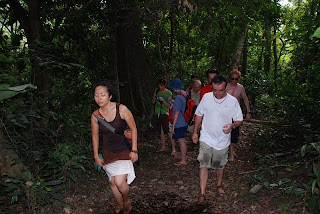
We then had a hot, steamy, delightful walk through tropical jungle, in order to reach a waterfall.


It is the dry season, so we eventually arrived at a no-water, waterfall! However, the scenery and plant and animal life were awe-inspiring and we had a great picnic of leftovers from Christmas day.


Today, Sunday, we travelled to Accra and have toured the main sites and museums. We were really interested to learn about Nkrumah’s life and Pan African aims. We saw our first examples of colonial forts and slave dungeons. Our Ghanaian guide had an amazing perspective on slavery i.e. some aspects of slavery are very positive, because the descendents of slaves are now in Europe and America, and therefore they are able to send money and support back to Ghana to aid its development – so that’s alright then!!

One particular display shows a series of pictures of the first presidents of African countries, taken as the country gained independence from colonial powers.


The president’s palace in Accra is currently the centre of a major controversy. The new government has many socialist aims. In line with this, there is a plan to use the palace and its grounds for breeding chickens, “as there are so many hungry people in Ghana”. Meanwhile, it stands uninhabited and unused ....so watch this space.

Monday, 21 December 2009

From Wa to Kumasi

It is now Saturday 19th December and the term has ended. We have had a busy couple of weeks, working with a number of schools and also continuing our evaluation of the Education Service. Linda has managed to convince one the headteachers to ban the use of the cane, so great success there. The Director of Education says that she feels more “in control” since we have been working with her, so we are well pleased.

The Director organised an end-of-year “round the table” discussion on Thursday evening to assess the year’s work, and to eat and drink. It was a very open meeting, with most people taking turns to stand up and say what they had observed about the work of the Service and how it can be improved.


There was then food for everyone, including beef, which is only eaten on very special occasions. The women who work in the office prepared the food for everyone – Gender roles are very deeply ingrained.


The dry season has now really set in. There is a real problem in the area with deforestation. Trees are cut down everywhere for fuel and the amount of savannah grassland is forever increasing. In the dry season, this leads to a number of local fires that are caused accidentally. In addition, food is short in many families and some people deliberately set fire to the grass, so that the bush rats will run out of the bush to escape the fire. The rats can then be speared, cooked and eaten.

All of this means that the surrounding countryside is a mixture of parched brown and burnt black, with the occasional tree adding a bit of green.


We are looking forward to seeing more tropical greenery, as we head South over the holiday period.

Sunday 20th December – Diary of the bus journey to Kumasi.

8.00 a.m. We are at Wa bus station having our tickets checked and our luggage weighed. Tickets cost us approximately £5 each for a 5/6 hour journey. We are travelling by STC, the State Transport Company.

9.30 a.m. The bus was due to leave at 9.00 a.m., but the loading hasn’t yet started. Two men are attacking the engine, one with a spanner and one with buckets of water. We think there might just be a problem! All the passengers are waiting patiently, completely unperturbed. We’ve decided to settle down and read our books.


11.00 a.m. The bus is on its way. Yippee.

11.30 a.m. The passengers are very quiet; many are dropping off to sleep. We are passing through a very parched landscape with huge termite mounds and the occasional mud-built village.

11.40 a.m. The bus has been chugging rather slowly. We have stopped twice in the last 10 minutes to put water into the engine. We are now completely stationary, with a lot of people looking at the engine and scratching their heads. All the passengers are chatting calmly, and the children are enjoying a run outside the bus – back to reading our books.


12.40 p.m. We have chugged along for another stretch, stopping by every available water supply to collect water to cool the engine.


1.30 p.m. The air conditioning has been switched off, because of the overheated engine. This is the hottest part of the day, and the bus is hot, hot, hot ........ We are conserving our personal drinking water supplies.

2.00 p.m. Another water stop. All the women from the local village seem to be out doing their washing by the side of the road. We are trying to practice our Waali with them, but sign language and lots of smiles are proving to be much more effective.


3.45 p.m. Another stop – on the edge of a town this time. The whole bus empties, as we dash to the nearest shop to buy drinks – wonderful. Apparently, a replacement bus is being sent to us. Meanwhile, we are sitting on the road by the edge of a lake, as we begin to appreciate the cool of the late afternoon and watch the local women doing their washing. (No idea where the men are; they must be extremely busy somewhere.) At this point, we are not far from the border of Cote d’Ivoire.


5.00 p.m. Still here. People are sharing food with each other. The children have now plucked up courage to touch our skin and shake our hands. They are now calling us Aunty Nansarla and Uncle Nansarla (white person). There is a really great atmosphere.

6.00 p.m. Still here – and we are getting pretty tired. However, we are making progress with 2 very good books: The Robber Bride by Margaret Atwood and The thing Around Your Neck by Chimamanda Ngozi Adichi (a series of short stories set in West Africa). Key learning point; carry a good book whenever travelling in Ghana!

6.15 p.m. Still here. It’s now getting dark. The bus is being unloaded – and we really don’t know why we are surprised that a live goat is being brought out amongst all the suitcases from the luggage compartment under the bus. The children are singing every English song they know to us. The mosque across the road is calling people to prayer. We are settling down on the ground outside watching the moon and stars.


8.15 p.m. Still here ...........but a replacement bus has just arrived. We are all coming to life again, having lulled ourselves into a half-sleep.

9.00 p.m. We’re off. There’s a general air of hilarity (or maybe it’s hysteria), as the driver has a bit of difficulty starting the bus.

2.30 a.m. Monday We have arrived in Kumasi. Much of the journey through the night was smooth. Some of it was very bumpy, as we negotiated rough, unsealed roads. Now to our taxi and on to the hotel ........phew.

2.35 a.m. Whoops. We have left some of our things on the bus, and the bus has set off again, heading for Accra. Our taxi driver is great and does a mad chase to catch up with the bus .......Success. We have managed to get our things back. The people on the bus seemed pleased to see us again! Those who were still awake anyway.

3.00 a.m. In our hotel. Lots of shiny marble everywhere – unreal. Warm shower – bliss.

3.30 a.m. Good night. Zzzz.........

Monday, 14 December 2009

A day in the life of Wa Model Primary School

We are working with a wide range of schools, but we are doing more intensive work with 8 schools. One of these is Wa Model Primary School, which is the most "privileged" school that we have visited. You will see in the pictures that there are solid school buildings, an electricity supply and a water supply on site, and the pupils are wearing shoes. In addition, most classes have 50/60 pupils, which is a comparatively small class size for this region.

Many primary school children in Ghana wear a brown and yellow uniform, and you will see that many of them are wearing coats and jackets over their uniform, as it is now the dry (cold!) season. This school is called Wa “model” school, because it was the first school ever to be built in Wa. This was in the early 70s, and it was seen as a model for other school buildings.


There are over 800 pupils in the school and they arrive at school at approximately 6.30 a.m. They all have cleaning duties that are carried out amazingly enthusiastically before the school day begins. Brushes made of sticks are used to sweep up leaves and rubbish.


Classrooms are also swept out.


All leaves and rubbish are collected in a bin and then taken to the rubbish dump on the perimeter of the school.


Water collection is an important job for pupils. The water is stored in 3 barrels in the central part of the school. A few plastic cups are kept with the barrels and all pupils use these cups when they are thirsty.


Five women from the local community come onto the school site from 6.30 a.m. onwards to sell food to the pupils. This food is very reasonably priced and quite a number of the pupils buy it. They can buy pieces of fruit, some nuts or a bowl of rice with some stew. The women who sell the food have all been medically checked to ensure that they don’t have any long-term illnesses.


The pupils are very well behaved and there are excellent relationships among them. The older pupils act as prefects to ensure that everyone behaves during the consumption of the food.


At 7.15 a.m., one pupil has responsibility for ringing the bell


At this point all pupils line up in their classes around the flag of Ghana. This is all very precise and they have to organise themselves, so that they are standing up straight at arm’s length from the pupil in front.


The assembly starts with a prayer, followed by all pupils and staff with arm across the chest, reciting the Ghana pledge and then singing the national anthem. This is taken very seriously indeed. At this point, information is given to the pupils or sometimes the pupils themselves talk to their peers. Pupils leave the assembly, class by class, marching and singing the school song: “...we are all involved in making our country strong........” They all engage in this very enthusiastically and sing their hearts out.


All the marching takes places to the beat of drums that are played by pupils – always boys. (We haven’t tackled that one yet!)


Marching is a very popular activity in all the schools and there are annual marching competitions. Wa Model Primary has won a prize every year in recent times.

Lessons begin at 7.45 a.m. and there are 8 lessons each day. Each class teacher takes all the subjects. The centrally-prescribed curriculum is made up of English, maths, Ghanaian language (Dagaare), citizenship education, integrated science, creative arts, religious and moral education, and ICT. The picture below shows a year 5 class.


The year of the class bears no relationship to the age of the students. It represents the number of years they have been in school. Therefore, there are pupils up to the age of 18 in the primary school. All text books are provided by the school, but even this school is very short of books. All exercise books, pens, pencils etc. have to be provided by the pupils.


There is a 20 minute break at 10.30 a.m., when pupils can still buy food from the food sellers. School ends at 1.30 p.m. There is no food provided free for pupils, and this is a major issue for the poorer pupils who have to go for the whole day without anything to eat.

We haven’t been anywhere that is goat-free. The goats even attend the schools:


Having a picture taken is a real novelty – even for the teachers, who insisted on having their picture taken as well.