Monday, 7 March 2011
Monday, 3 January 2011
Building in progress
Money that we previously donated to specific schools is now having an impact. This first picture shows building work that is taking place at Nakore Primary School.
This building will enable the Kindergarten class to be taught in a room, rather than under the mango tree as they are presently. The picture below shows the kindergarten class where they are currently taught. The lack of a building means that they are unable to attend school for most of the rainy season.
Nakore is a lovely village just south west of Wa. It is the place to which we made one of our very first excursions on our bicycles when we first arrived in Wa. The blog entries of 24th October 2009 and 6 March 2010 give more details about Nakore.
A big thank you to all who have contributed to our fund. We now have another £2,000 to distribute thanks to the generosity of our family and friends this Christmas. As soon as Ruby returns from her trip to the Philippines, we will arrange the transfer of the money and get an update on what is happening on the ground. This donation will contribute to the building of boreholes in isolated villages.
This term we will be delivering assemblies in a school and giving a talk to a local Rotary Club, in order to promote the work of VSO and, hopefully, to raise additional funds.
Thursday, 28 October 2010
Supporting Wa Municipal
• Provision of electricity to isolated schools.
• Provision of school furniture
• Establishment of boreholes in isolated villages
• Setting up women's groups to earn income and become self-sustaining
• Building a primary school in the village of Naku
We are liaising with local people who will ensure that all funds raised will go directly to these projects. So far we have sent money to support three schools with whom we worked when in Ghana.
A local Wa secondary school has received money to buy furniture for the classrooms.
The School Management Committee of Nakore Primary School was recently presented with a cheque to buy a generator, so that their staff and students can use a computer as part of their ICT studies. The cheque is being handed over by Ruby, our great, VSO friend and colleague based in Wa.
The government has rightly promoted ICT in the curriculum. It is now a compulsory subject across Ghana, but it is currently taught using a blackboard and chalk. Readers of this blog will recall when we took our laptop to Nakore to show them ICT in action:
Dodiyiri Primary School was where we drew an alphabet frieze – see the blog entry for 14th November 2009. They now have money towards their new classroom. At present the youngest children are taught outside the main school building under a very flimsy verandah, as shown.
We will continue to look for a really generous benefactor, because it would be wonderful to build a school in Naku. See the blog entry for 4th December 2009 for the detail of Haydn’s visit to this village.
If anyone reading this blog is interested in contributing and has not received detailed information from us, please email us at landhpowell@msn.com. We will update this blog monthly with any progress we are making. In the meantime, all the very best to our friends and colleagues in Ghana.
Sunday, 4 April 2010
Back to London
We have been away from Wa now for almost two weeks. However hard we tried, preparing for the cold, damp and grey of London was not easy. Walking out into the tropical warmth of Wa and Accra is something we shall miss.
This is the last entry to this blog as we move onto a new chapter in our lives. We are looking forward to meeting up with all family and friends over the next few weeks. We are also looking forward to starting work with aspiring senior leaders in education. We have some work at an International School in Switzerland and will spend a lot of the summer looking back on some very happy Ghana memories.
We will maintain ongoing contact with schools, colleagues and VSO volunteers in Wa. We will also enjoy meeting up with friends from Ghana as they come back to, visit, or pass through, London. One thing is clear to us, and that is the intensity of our VSO experience will live with us for the rest of our lives.
Thank you so much to all those who have taken an interest in our time in Ghana and for all the support we have received. If anyone is interested in finding out more about volunteering with VSO, please don’t hesitate to contact us.
Sunday, 28 March 2010
Togo & Benin
It feels good to be in French-speaking countries, that have cheese, coffee and whole-meal bread! Togo and Benin are both very poor countries. The United Nations uses the “Human Development Index” as a measure of the wealth, welfare and state of development of a country. This index includes comparative measures of life expectancy, literacy, education and standards of living. Out of 182 countries, Norway is top; the USA is 13th and the UK is 21st. Ghana is ranked at 152, with Togo at 159 and Benin as 161. Sierra Leone, Afghanistan and Niger are at the bottom.
According to 2008 figures, all 15 West African countries together owe a total of 75 billion dollars to rich-world lenders. This averages out at more than 300 dollars for every adult and child. To put this into a global perspective, this debt is the equivalent to 2 months of the USA’s annual defence expenditure of approximately 450 billion dollars.
We have spent a short amount of time in Togo, the smallest country in West Africa, with a population of about 6 million. The border crossing from Ghana to Togo was the most busy and chaotic that we have ever encountered. It was fascinating to just sit and watch everything happening. Somehow or other, we managed to get visas and enter Togo.
Lome, the capital, is a very sad place. It reminds us so much of our visit to Haiti years ago, in that there are typical French, tree-lined avenues, bordered by once-beautiful buildings, including hotels, that are now in a state of decay or are closed down completely. Lome was once a centre of international trade from all over the world, whereas now it is clearly struggling. The “grand marche” and other market areas have empty stalls. There are many unemployed young people around, and there is an air of desperation in the streets.
Much of this situation is due to Togo’s recent history. The country became a German protectorate in 1884 (called Togoland). The Germans used forced labour and other repressive measures to ensure the production of coffee and cocoa. At the end of the First World War, a third of Togoland was placed under British administration and two- thirds, corresponding to the current borders of Togo, was placed under French administration. (The British third of the original Togoland is now part of Ghana.)
The Germans and then the French groomed a class of coastal peoples to be an educated elite of civil servants. After independence in 1960, these peoples inherited political power and economic advantages, leading inevitably to ethnic tensions, which have continued ever since. Added to this is 38 years of rule by a military dictator, Etienne Eyadema, during whose time thousands of people died, as a result of his repression, torture and murder.
In 2005, his son Faure Gnassingbe took over the presidency. The first, fairly peaceful democratic elections took place in 2007. There were further peaceful elections this February, and Gnassingbe remains in power. Togo’s relations with Ghana and Benin are very tense, since both countries are accused of harbouring and supporting political exiles from Togo during recent decades.
We visited Togo’s small national museum in Lome. This features musical instruments, including the iron instrument below, which is still used today, both for ceremonies and for summoning people in the villages to come together at important times.
Both Togo and Benin are part of what was once called the “slave coast”. The centre of the slave trade in Benin was the town of Ouidah, where some of the largest slave markets were sited. Here we visited some very moving monuments to the slave trade. The “gate of no return” marks the spot where slaves were loaded onto ships in chains and sent mainly to Brazil (by the Portuguese) and Haiti (by the French). The last slave ship (Portuguese) left Ouidah in1885.
Before being loaded onto ships, each slave had to circle the “tree of forgetfulness”, 9 times for men and 7 times for women. This was aimed at making them put all memories of their homes, families and culture behind them. This monument is positioned where the tree once stood.
The Christian churches in Benin recognise the significant role they played in supporting the slave trade and, in recent years have erected a monument to the slaves and the abolition of the slave trade.
As in Ghana, there are many religious practices in both Togo and Benin, including Voodoo. We first came across Voodoo in Haiti and, of course, slaves from this part of Africa took their Voodoo beliefs with them to Haiti.
Most followers of Voodoo believe in a supreme god, Mawa. The word Voodoo refers to the spirits or intermediary gods, all of whom are associated with the natural world or with the ancestors (as in Ghanaian traditional religions). There are male and female Voodoo priests who are said to be able to become “possessed” by the spirits, thus displaying the positive or the negative emotions of any particular spirit.
The benevolence of the spirits is sought by making offerings at special fetish shrines. (A fetish is an ordinary object imbued with the sacred power of one or more of the spirits.) There are many voodoo temples and fetish shrines around both Togo and Benin. One of the spirits, Dangbe, who is associated with life and movement, is represented by the snake. The picture below shows the “Temple of the Python” in Oidah, which is dedicated to Dangbe. Here, we had the pleasure of fraternising with several dozen live pythons. These pythons are sacred and they roam around the town to feed, always returning to the temple.
Across the road from this temple is a Portuguese Christian church. It is clear that many people (known as 50:50s) integrate their traditional voodoo beliefs with their Christian faith, and they visit both the temple and the church on the same day. The Catholic saints, like the Voodoo spirits, are viewed as the intermediaries to the supreme God. For example, St. Patrick is seen as the incarnation of the snake spirit, Dangbe.
Benin is a country of about 9 million people. It has virtually no mineral wealth and relies heavily on the production and sale of both palm oil and cotton. On the world markets, it has to compete with countries that have the resources to subsidise their cotton industry, notably the USA. This obviously adds to Benin’s economic problems.
We stayed for 3 nights in the business capital, Cotonou. Unemployment is very high, and people have clearly found ingenious ways of making a living. For example, there are thousands of motorbike taxis, with no number plates or crash helmets. This whole business is unregulated, but the government turns a blind eye, because of the lack of alternative opportunities for people to make a living, not to mention the absence of alternative means to move around the city.
The same is true of the sale of fuel for cars and motorbikes. Throughout Cotonou and the capital city, Porto Novo, there are numerous roadside stalls piled high with plastic bottles of fuel for sale. This fuel is smuggled illegally from nearby Nigeria, but the government again takes no action, because at least people are able to have a livelihood.
Just north of Cotonou is Lake Nokoué. We had a very interesting visit to a stilt village on this lake. Ganvie is the largest stilt village in West Africa, with a population of about 30,000 people. We were taken by boat, 5 kilometres across the lake to get to the village.
Everything is on stilts: houses, shops, cafes, schools etc. All movement between the various buildings is by canoe.
The village relies on fishing. They have a very clever mechanism for trapping the fish. They plant branches under the water to form a network of fences in which fish become trapped. Gender roles are very clearly defined. Men and boys do all the setting of traps and fishing.
Women and girls take the fish to market on the edge of the lake in their canoes.
At the market, the women sell the fish and use the money to buy provisions both for their families and to sell back in Ganvie. It is clearly a very hard life, lived out in a very challenging environment.
Ganvie has been in existence for over 300 years. The people are of the Tofinu tribe. During the 16th and 17th centuries, people from the powerful kingdom of Da Homey (further north) raided other villages to supply slaves to meet the demands of the European slave traders. The Tofinu escaped and set up their village on the lake. (Ganvie means “safe community”.) They were safe here, because the religious beliefs of the Da Homey people prevented them from crossing over water.
We are now back in Ghana. The BA strike has delayed our return home by one day only, we hope. Our final blog entry should come from London next week.
Sunday, 21 March 2010
Our last week in Wa
On Tuesday night it was our bean burger feast, with 7 of us eating. Cam, who has had several meals with us, awarded Linda a certificate for her “culinary skills with 8 basic ingredients”.
On Wednesday morning, we were visited by Faustina and her son, Bonga.
Faustina is one of the most impressive teachers with whom we have worked. She brought us gifts of fabric to make some Ghanaian clothing to wear back in the UK. While she was with us, she gave us a lesson on how “Ghanaian women back their babies”. We just love the way Ghanaian women carry their babies on their backs; the babies always seem so contented.
On Wednesday afternoon we undertook another new and different Ghanaian experience – a football match. The Wa Allstars football team has two international players and the team is in the top flight of the Ghanaian premier division. Their ground is very underdeveloped, and the match was played before less than 1000 people. It was a very fast match, with impressive skills and judgement from the whole team. Wa won 3 to 1, playing against a team from Sekondi, which is in the south of the country. As the third goal went in, the local crowd was well pleased.
Thursday saw the farewells from our GES colleagues. We all sat under a mango tree at a local spot, within the Wa parade ground. In true Ghanaian style, the event was conducted in a very formal manner. There was a master of ceremonies and an agenda, with one speech after another.
We were presented with numerous sets of Ghanaian clothes, and it really was a great occasion.
In Haydn’s speech, he gave colleagues a new acronym – as acronyms abound in this country:
Generous, Hospitable, Advancing, Nation of Africa
As a result of all the gifts we received, we had to buy something else on Saturday!
Every single leaving gift is really special, including the bag of mangoes given to us by our local shopkeeper, Memuna, and the 2 bottles of water given to us by our taxi-driver friend, Ecowas.
We are reflecting on the amazing experience we have had in Wa - the life changing opportunity given to us by the people of Ghana, by VSO and by all those in the UK who have supported us. Without the support of our families, friends, colleagues and neighbours we could not have left our two foster sons or our house in London for 6 months. We look forward to seeing you all again soon.
Family members have raised money, cajoled donations of computer parts, negotiated prices of scissors, rulers, pens and such like, parcelled them and despatched them. All this has enhanced the contribution we have been able to make in Wa.
We have made some wonderful friends amongst VSO volunteers and local people, most of whom we shall never see again. Many of the local people dream about travelling to Europe, but the cost of the airfare is prohibitive.
We will definitely miss all the local children. Every morning they greeted us as we cycled to work. The daily refrain from the children will stay with us forever: “Nansarla, how are you? We are fine. Thank you.” We shall miss their bright eyes, their keen interest in things and their enormous desire to learn, to better themselves, and thus gain the ability to support their families. We reflect on the lost opportunities, simply because children have to collect water, have very little to eat, lose parents, have to prepare food daily for a whole family etc. etc.. If they had been born elsewhere in the world, how different their lives could have been. The singing, the playing of games, the laughter of the local children will definitely stay with us.
We will miss all our wonderful neighbours, who were always willing to help out if we needed advice or support. Their warm hospitality has been absolutely wonderful. We will also miss the local shopkeepers, with their cheery ‘ansoma’ (good morning) every day as we cycled to work, as well as their delight when we spent even a few pence in their shops.
Our work colleagues, both within the Education offices and in the schools, have been a true inspiration. They have always been open to new learning. They are also fiercely proud of their achievements to date. They have a strong desire to contribute to the development of the young nation of Ghana, and they are willing to make sacrifices, so that the whole community can better itself and support its children in gaining a decent education. The energy and enthusiasm of the people with whom we have worked will go with us forever and we wish them all every success for the future. We intend to support them in any way we can from the UK.
There is nowhere in the world that we have ever found such a welcome to ‘rich white people’, and where there is no expectation that we will give money. On the contrary, there is a generosity that seems to know no bounds. In the middle of the harsh dry season when food and water are short, people are still willing to share their meagre supplies.
The Christmas bonuses given to employees of the US firm Goldman Sachs were, in 2009, greater than the Gross Domestic Product of Ghana. (GDP is the market value of everything – goods and services – produced in a country during the year. It is one of the best indicators of standard of living.)
Tuesday, 16 March 2010
Precious Water
We have had no water to the house for 2 weeks. This means that we have had to go to the bore hole to fetch water. As there is such a general shortage, there are always lengthy queues at the bore hole. On the most recent visit there were 59 people queuing for water. Everyone is so friendly and helpful and they insist that we go to the front of the queue. They also help us to fill our containers and insist on carrying them back to the house for us.
More children are being kept off school to fetch and carry water. The picture below was taken at 10.00 a.m. on a week day, when all these young people should have been at school.
Our neighbours have been amazing. They keep checking that we have water, and they sometimes appear at our door with containers of water for us. Yesterday (Sunday) we completely ran out of water, apart from bottles of drinking water. Unfortunately, this coincided with Greg having a bout of food poisoning - and hence a greater need for water! A couple of our wonderful volunteer colleagues came to the rescue and did several trips with their motor bikes to bring us water from the centre of town.
There are few business enterprises in Wa on an industrial scale. Packing safe water is a cottage industry that thrives all year round. Water is filtered and packed into plastic sachets, safe to drink and at the cost of about 2.5p a sachet. The lorry below is loading up with these packages to deliver to the shops. Water-borne diseases are very common, and we have seen many people drinking water that is clearly unfit for consumption.
We thought we would try and capture a few more Wa business enterprises like weaving
The nearest thing to a Department store is Foka. We have bought our kettle, buckets, cleaning materials, stationary, coat hooks and other miscellaneous items from this store.
It is a long time since we have seen typewriters in use. This guy sits outside the post office and for a small fee types up personal and business letters and a range of legal documents for his customers.
The assistant in our local stationary shop was delighted to have his photograph taken, as we are one of his best customers.
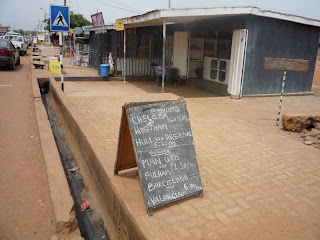
There are many other small enterprises around town, including a pharmacy that supplies the whole of the Upper West region, many tailors that will make good quality clothing for a very reasonable price, metalworkers, internet cafes and numerous food stores. Apart from churches the drinking spots are probably the most common businesses, many with a TV showing European Football. The picture below tells its own story.
One highlight of Wa life this last week has been the “enskinment” of the new paramount chief for Wa, called the Na. After 10 years of dispute, the Council of Chiefs has finally decided who should be the Wa Na. The enskinment is a traditional ceremony, where the new Na is dressed in a lion’s skin to represent his strength, power and authority. As part of the ceremony, he has to jump over a cow. This act represents long life for the Na.
Unfortunately, we did not witness any of this. The ceremony was carried out with a small number of people present, because the decision to enskin this particular WA Na is not universally popular. The picture below shows the Wa Na’s Palace, which is situated just off the main street of Wa.
We have gradually started to recognise that we are nearing the end of our time in Wa. On Saturday, we had a really good time at a regional meeting followed by a farewell lunch with all the volunteers in the Upper West region. Many of them had travelled quite a long distance, and it was a very happy/sad occasion.
On Sunday, the Deputy Director of Education, George Guri, invited us out for a farewell drink at our local spot. We have worked closely with George and he has just been appointed to the post of Director of Education in the Volta region of Ghana. In addition to the excellent work he does for the education service, he leads a group of people who are trying to set up a “science academy” in Wa. All the schools lack facilities for science, and his idea is to bring students into the academy on a rota basis, in order to participate in practical science. He is also the producer of a weekly radio programme, which aims to bring “useful, everyday science” to local people. This week’s programme included tips on how to make candles last longer. A recent programme explained how to plant and care for grafted mango trees. In addition to this, he works very hard to raise money to buy clothes, shoes, school books etc. for a number of really disadvantaged youngsters, in order to prevent them from dropping out of school.